Top Advantages and Disadvantages of Microphone in 2026
Struggling with an unclear voice in online meetings or poor audio while recording? You are not alone.
Many people face these issues because they do not understand the pros and cons of microphone properly. A microphone can solve your voice problems, but only if you choose and use it the right way.
In this article, I will explain the advantages and disadvantages of microphone in simple words, so you can avoid common mistakes and improve your sound quality. You will also learn practical uses in daily life.
So, stay with me in this journey and fix your audio problems step by step.
Advantages of Microphone
A microphone is a useful device that helps capture and transfer sound in a clear way. It improves how we speak, record, and communicate in daily life.
From online meetings to music and content creation, it plays an important role in many areas. It makes the voice stronger, clearer, and easier to understand for others.
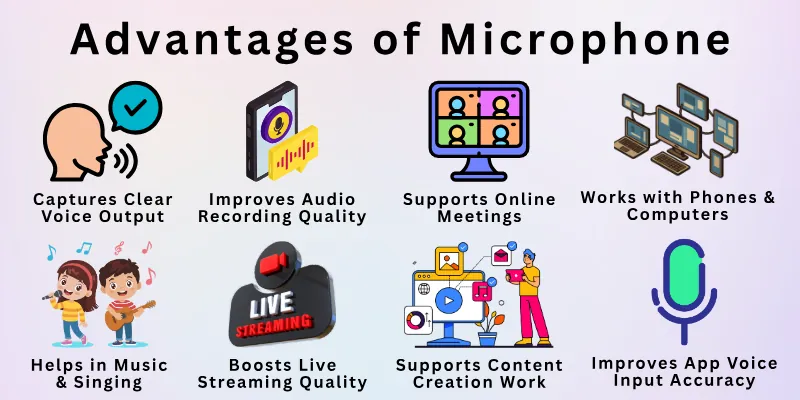
Here are the microphone advantages:
- Captures Clear Voice Output
- Improves Audio Recording Quality
- Supports Online Classes and Meetings
- Works with Phones and Computers
- Allows Wireless Movement Use
- Useful for Public Speaking Events
- Helps in Music and Singing
- Enables Hands-Free Communication
- Boosts Live Streaming Quality
- Supports Content Creation Work
- Improves App Voice Input Accuracy
- Saves Time in Group Communication
Let’s look at the microphone benefits in detail.
1. Captures Clear Voice Output
One of the main benefits of microphone is that it helps your voice reach others in a clear and strong way. It improves how you speak and how others listen to you. You do not need to shout or repeat yourself. The sound becomes more stable and easier to understand in different situations, like meetings, classrooms, or public speaking.
This also helps when people are far away from you. Your voice still sounds natural and smooth. It reduces confusion and makes communication more effective in daily life and online conversations.
- Improves clarity in noisy environments without extra effort
- Helps maintain natural voice tone during long conversations
- Supports a better understanding in group discussions
- Reduces voice strain in speaking sessions
- Works well for both close and long-distance communication
- Makes speech more confident and controlled
Pro Tip: Keep the mic slightly away from your mouth to avoid harsh sound and get balanced audio quality.
2. Improves Audio Recording Quality
Another major advantage is better audio recording quality. It helps you capture sound in a clean and professional way. Your voice becomes more detailed and balanced compared to built-in device audio. This is very useful for videos, podcasts, and music work where sound quality matters most.
It also reduces unwanted background noise during recording. This makes your final output clearer and easier to listen to. As a result, you spend less time fixing sound issues during editing.
- Captures voice details that built-in devices often miss
- Reduces background noise during recording sessions
- Improves clarity in video and podcast content
- Supports smooth editing with cleaner audio tracks
- Helps maintain consistent sound quality in long recordings
- Makes content more professional for audiences
Tip: Always record in a quiet space to get the best sound results.
3. Supports Online Classes and Meetings
One of the key benefits is smooth communication in online learning and meetings. It allows teachers, students, and professionals to share ideas clearly without interruptions. This improves understanding during live sessions and discussions.

It also helps people stay focused because voice delivery becomes more stable. When sound is clear, instructions are easier to follow, and mistakes are reduced in communication.
- Improves interaction during virtual classes
- Supports clear communication in team meetings
- Helps reduce misunderstandings in instructions
- Keeps discussions organized and smooth
- Works well with popular online platforms
- Enhances attention during long sessions
Fact: Clear audio in online learning improves student participation and focus.
4. Works with Phones and Computers
Compatibility with multiple devices makes it very useful in daily life. You can easily connect it to phones, laptops, and desktop systems. This flexibility helps in calls, recordings, and online communication without extra tools.
It also supports different applications without setup difficulty. This makes it convenient for both personal and professional use.
- Connects easily with mobile and computer devices
- Supports most communication and recording apps
- Works without complex installation steps
- Helps in switching between devices quickly
- Useful for remote work and travel use
- Improves productivity in digital tasks
Example: You can record on your phone and edit the same file on your laptop easily.
5. Allows Wireless Movement Use
A wireless setup gives complete freedom to move while speaking. You are not limited by cables or fixed positions. This is very helpful in presentations, teaching, and live events where movement matters.
It also improves confidence because you can interact naturally with your audience. This makes your delivery more engaging and flexible.
- Supports free movement during speaking or performing
- Removes the restriction of wired connections
- Useful for stage shows and public speaking
- Helps in outdoor and large event spaces
- Makes presentations more dynamic
- Reduces cable management issues
Pro Tip: Always check battery status before using wireless setups in events.
6. Useful for Public Speaking Events
A strong sound system is important in seminars, conferences, and stage programs. It helps speakers deliver messages clearly to large audiences. This reduces the need for voice strain and improves audience understanding.
It also supports better focus during speeches. When people hear clearly, they stay more engaged in the topic.
- Helps reach large audiences without effort
- Improves speech clarity in formal events
- Reduces stress on the speaker’s voice
- Supports better audience engagement
- Works in indoor and outdoor setups
- Improves overall event communication
Insight: A good sound setup increases audience attention during live events.
7. Helps in Music and Singing
It plays a strong role in music production and singing performance. It helps capture voice tone, rhythm, and emotion clearly. This is important for both studio recording and live shows.
It also allows singers to control their voice better. This improves sound balance and performance quality.
- Captures accurate vocal tone and emotion
- Supports studio recording and mixing
- Improves live stage performance
- Helps control pitch and sound balance
- Works with instruments in music production
- Enhances overall sound expression
Fact: Most professional music recordings depend heavily on high-quality audio capture tools.
8. Enables Hands-Free Communication
Hands-free use makes communication easier during multitasking. You can speak while doing other tasks without stopping your work. This improves convenience in daily life.
It also supports safer usage in activities like driving. You can stay connected without using your hands.
- Supports voice calls without holding devices
- Helps during driving and cooking
- Improves multitasking ability
- Reduces manual typing effort
- Works with smart assistants
- Saves time in communication tasks
Tip: Voice commands work best in quiet surroundings.
9. Boosts Live Streaming Quality
Clear audio is very important in live streaming. It helps viewers understand content without difficulty. This keeps them engaged for longer periods.
It also improves interaction between the streamer and audience. Good sound builds trust and professionalism.
- Improves viewer experience during live sessions
- Supports gaming and entertainment streams
- Reduces audio delay issues
- Enhances audience engagement
- Works with streaming platforms easily
- Builds strong content quality
Insight: Viewers leave faster when audio quality is poor, even if the video is good.
10. Supports Content Creation Work
Content creators depend on clear audio for better engagement. It improves videos, podcasts, and social media content. Good sound helps attract and retain audience attention.
It also supports different types of creators across platforms. This makes content more effective and professional.
- Improves storytelling in videos
- Supports podcast creation
- Increases audience engagement
- Helps in brand building
- Works with editing software
- Expands content reach
Example: Many successful creators focus more on sound quality than visuals.
11. Improves App Voice Input Accuracy
Voice input tools work better with clear sound. It helps in faster typing, searching, and command execution. This saves time and reduces manual effort. It is very useful for mobile users who prefer speaking over typing.
- Improves voice recognition accuracy
- Supports faster text input
- Reduces typing workload
- Works with AI assistants
- Speeds up digital tasks
- Enhances mobile usability
Fact: Better voice input improves accuracy in smart apps and assistants.
12. Saves Time in Group Communication
Group communication becomes faster and more efficient. People can share ideas in real time without confusion. This improves teamwork and decision-making. It also reduces repeated explanations in discussions. This saves time in both office and online meetings.
- Speeds up group discussions
- Reduces communication delays
- Improves team coordination
- Supports clear idea sharing
- Helps remote collaboration
- Increases productivity in meetings
Tip: A clear audio setup can save several minutes in every meeting.
Disadvantages of Microphones
Microphones are useful tools, but they also come with some limits that can affect sound quality, performance, and ease of use in real situations.
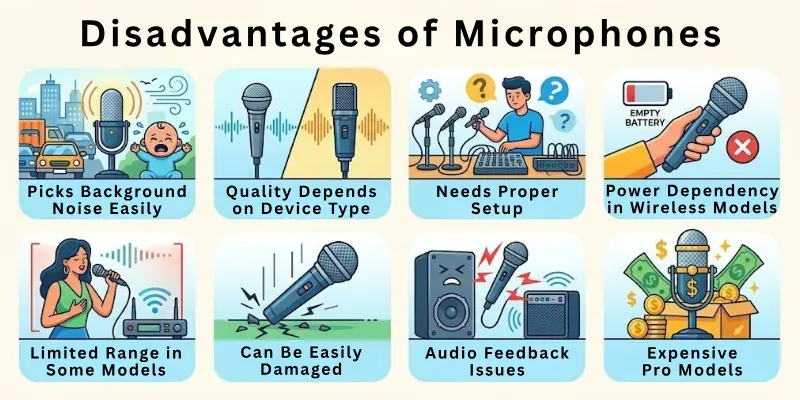
Here is the list of microphone disadvantages:
- Picks Up Background Noise Easily
- Sound Quality Depends on Device Type
- Needs Proper Setup and Adjustment
- Power Dependency in Wireless Models
- Limited Range in Some Models
- Can Be Easily Damaged
- Audio Feedback Issues
- Expensive Professional Models
Now let’s explore each mic disadvantages in detail, one by one.
1. Picks Up Background Noise Easily
One major drawback is that microphones often capture unwanted sounds from the environment. This includes traffic, fans, keyboard typing, or nearby conversations. These extra sounds mix with your voice and reduce clarity.
In real situations like online meetings or recordings, this becomes a serious problem. Even small noise can disturb the listener and reduce focus on the main message.
- Captures surrounding sounds along with voice
- Reduces clarity in busy environments
- Affects professional audio quality
- Distracts listeners during communication
- Increases editing work after recording
- Weakens overall sound focus
Tip: A quiet room or noise filter setup improves results significantly.
2. Sound Quality Depends on Device Type
Another limitation is that not all microphones produce the same quality. Cheap or built-in models often give weak and unclear sound. High-quality results usually require expensive devices.
This creates difficulty for beginners who want good audio without spending much money.
- Low-cost devices produce unclear sound
- Built-in mics have limited performance
- Quality changes with brand and price
- Budget options lack advanced features
- Inconsistent output in basic models
- Professional quality needs a higher investment
Fact: Mid-range microphones often give the best balance between cost and quality.
3. Needs Proper Setup and Adjustment
Microphones require a correct setup to work properly. Wrong placement, angle, or settings can reduce sound quality. Many beginners face issues when using them for the first time. Even a good microphone can perform poorly without proper adjustment.
- Needs correct positioning for clear output
- Wrong settings reduce voice quality
- Requires testing before use
- Beginners may face learning difficulty
- Small errors affect the final sound
- Needs basic technical understanding
Pro Tip: Always do a short sound test before important use.
4. Power Dependency in Wireless Models
Wireless microphones rely on batteries or charging. If power runs out, the device stops working immediately. This can interrupt important events or recordings. This becomes risky during long sessions or outdoor use.
- Requires regular charging or battery replacement
- Can stop working without warning
- Limited usage time per charge
- Not reliable without backup power
- Battery life decreases over time
- May interrupt live events
Insight: Always keep a backup power source during events.
5. Limited Range in Some Models
Some microphones only work well within a short distance. When you move away, sound quality drops or the connection becomes weak. This limits movement and flexibility. It becomes a problem in large spaces like halls or outdoor areas.
- Weak signal beyond a short distance
- Audio drops in low-range models
- Not suitable for large venues
- Limits speaker movement
- Causes delays or interruptions
- Depends on device strength
Example: Basic microphones may fail in large conference halls.

6. Can Be Easily Damaged
Microphones are sensitive devices that need careful handling. A small drop, dust, or moisture can damage their performance. This reduces their durability compared to other tools. Because of this, users must handle them carefully during use and storage.
- Sensitive to physical damage
- Affected by dust and moisture
- Requires careful storage
- Repair can be costly
- Not suitable for rough use
- Needs a protective case
Tip: Always store microphones in a dry and safe place.
7. Audio Feedback Issues
Sometimes microphones create a loud echo or noise called feedback. This happens when sound loops between speakers and the mic. It can disturb communication in meetings or events. This problem usually comes from a poor setup or a wrong sound balance.
- Creates unwanted echo noise
- Happens due to system imbalance
- Disturbs live communication
- Interrupts audience focus
- Requires technical adjustment
- Common in speaker setups
Fact: Proper sound balancing removes most feedback problems.
8. Expensive Professional Models
High-quality microphones can be costly. Professional-grade devices used for recording or streaming require a higher budget. This makes them less accessible for beginners. Extra accessories also increase the total cost.
- High-end models are expensive
- Accessories increase total cost
- Budget models lack features
- Not suitable for all users
- Requires investment for quality
- Price increases with performance
Insight: Beginners can start small, but quality improves with better investment.
Factors to Consider Before Buying a Microphone
Before buying a microphone, you should understand what really matters for your needs. A good choice depends on how and where you plan to use it. Different microphones offer different features, so it is important to compare them carefully. This helps you avoid wasting money and get better sound quality.
You should also think about comfort, budget, and device support. A smart decision will improve your recording, communication, and overall experience.
- Sound Quality: Choose a microphone that gives a clear and natural voice output
- Budget: Pick a model that fits your price range without losing basic quality
- Purpose of Use: Select based on needs like gaming, recording, or meetings
- Device Compatibility: Make sure it works with your phone, laptop, or PC
- Wired or Wireless: Decide if you need freedom of movement or a stable wired connection
- Noise Cancellation: Look for features that reduce background sound
- Build Quality: Check strong materials for long-term use
- Ease of Setup: Prefer simple plug-and-play options for quick use
Future of Microphone Technology
Microphone technology is improving very fast with new digital tools and smart systems. In the future, microphones will become more accurate, more compact, and easier to use. They will focus more on clear sound and less background noise. This will make communication even smoother in daily life.
New upgrades will also improve how microphones work with smart devices and online platforms. This will help users in education, business, entertainment, and content creation.
- AI Noise Reduction: Future microphones will remove background noise more intelligently for a clearer voice
- Voice Recognition Improvement: Devices will understand speech more accurately in different accents
- Wireless Stability: Connection will become stronger with less signal loss during use
- Mini Size Design: Microphones will become smaller and easier to carry anywhere
- Smart Device Integration: Better connection with phones, smart TVs, and voice assistants
- Higher Audio Precision: Sound capture will become more natural and detailed
- Low Power Consumption: Devices will use less battery for longer working time
- Real-Time Processing: Voice will be processed instantly without delay
Final Thoughts
We’ve reached the end! In this article, we’ve covered the advantages and disadvantages of microphone in detail.
You now understand how microphones improve communication, recording, and online work, but also have some limits, like noise issues and quality differences.
I personally recommend choosing a microphone based on your main use, not just price, because the right choice makes a big difference in performance.
If you found this helpful, feel free to explore more guides and improve your tech knowledge.
Quick Answers to Common Questions
Here are some common questions and clear answers about the microphone advantages and disadvantages. These answers will help you understand how microphones work, where they are useful, and what problems they may have in real use:
A microphone makes everyday communication easier. You can use it for calls, online classes, and voice commands. It helps you share your voice clearly without effort.
It also supports many digital tools like voice search and video calls. This saves time and improves interaction in daily tasks.
A microphone improves online learning by making speech clear and easy to understand. Teachers and students can communicate without confusion.
- Better understanding of lessons
- Smooth group interaction
- Sometimes, an audio delay may happen
- A poor-quality mic can affect learning
So, it supports education, but quality matters a lot.
A microphone captures sound in detail, which makes recordings more professional. It is widely used in videos, podcasts, and music. It reduces distortion and improves clarity. However, background noise can still affect poor-quality devices.
Different microphones serve different purposes. Some are used for recording, while others are better for live use. Dynamic microphones are strong for live events, while condenser microphones are better for studio recording. USB and wireless types are popular for online use.
A microphone helps creators make clear and professional content. It improves audio in videos, podcasts, and live streams. This makes content more engaging for viewers. Good sound also builds trust and audience retention.
Most modern microphones work with phones, laptops, and computers. This makes them flexible for different users.
However, some models need adapters or special ports. Always check compatibility before buying to avoid issues.
Users may face issues like low sound, noise interference, or connection problems. These problems usually happen with low-quality devices or a wrong setup.
Proper placement and good settings can fix most issues. Regular checks also help maintain performance.
Beginners should focus on simple and easy-to-use microphones. USB microphones are often a good starting point.
- Choose a clear sound quality
- Check device compatibility
- Prefer an easy plug-and-play setup
- Stay within budget
A simple choice helps beginners avoid confusion and get better results quickly.


- Be Respectful
- Stay Relevant
- Stay Positive
- True Feedback
- Encourage Discussion
- Avoid Spamming
- No Fake News
- Don't Copy-Paste
- No Personal Attacks
- Be Respectful
- Stay Relevant
- Stay Positive
- True Feedback
- Encourage Discussion
- Avoid Spamming
- No Fake News
- Don't Copy-Paste
- No Personal Attacks