Future of Camera Technology: Trends Shaping the Way We Capture the World
Camera technology is changing very quickly. New phones, smart software, and better sensors have made photography easier than ever. Today, even a beginner can take high-quality photos with a simple device.
This fast change is happening because people want better photos and videos in less time. Social media, content creation, and online work have increased this demand. As a result, companies are adding smarter features like AI photo correction, automatic scene detection, and advanced zoom systems.
In this guide, you will learn how camera technology is evolving and what it means for the future. You will also see how smartphones, professional cameras, and AI tools are changing photography.
By the end, you will clearly understand what to expect from the future of camera technology.
How Camera Technology Has Evolved Over Time
Camera technology has changed step by step. Each stage made photography easier, faster, and more powerful.
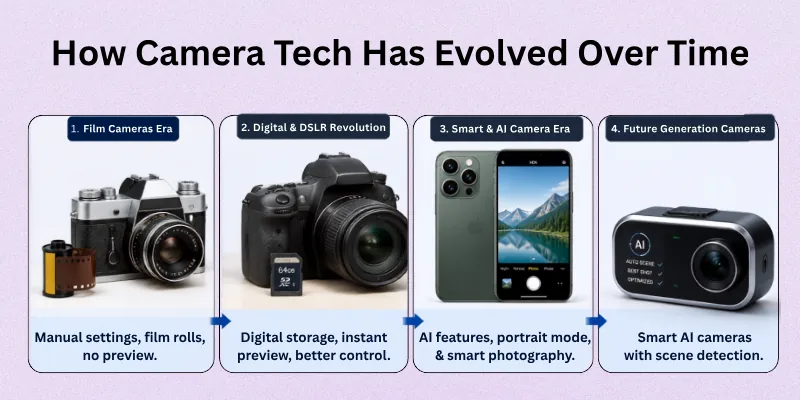
Let’s look at how it evolved from simple manual tools to smart AI systems.
Film Cameras Era
In the early days, cameras used film rolls to capture photos. Users had to set everything manually, like focus, lighting, and exposure. There was no screen to preview images, so people had to wait for film development. This made photography slow and limited, but it built the foundation of modern cameras.
Digital and DSLR Revolution
Digital cameras changed everything. People could now see their photos instantly and store them on memory cards. DSLR cameras improved image quality and gave more control over settings. Photography became easier, faster, and more flexible for both beginners and professionals.
Smart and AI Camera Era
Smartphones brought a major shift in camera technology. Cameras became part of everyday life. AI and computational photography started improving images automatically. Features like portrait mode, night mode, and scene detection helped users take professional-looking photos without manual effort.
Future Generation Cameras
Future cameras will focus on full automation and AI intelligence. They will adjust settings on their own, understand scenes in real time, and even suggest the best shots. These cameras will work more like smart assistants, making photography simple for everyone.
Future of Smartphone Cameras
Smartphone cameras are improving very quickly and becoming the main tool for photography today. They are no longer just simple cameras. They now use smart technology to take high-quality photos and videos with very little effort from the user.
Here is how smartphone cameras will get better in the future:
- AI-powered photo and video enhancement: AI will automatically improve lighting, colours, and sharpness to give better results in every shot.
- Improved zoom without quality loss: Future phones will offer powerful zoom features that keep images clear even at long distances.
- Better night and low-light photography: New sensors and AI tools will help capture bright and clear photos in dark environments.
- Multi-lens smart systems: Phones will use multiple lenses together to improve depth, detail, and overall image quality.
- Real-time scene detection: Cameras will instantly understand what you are capturing and adjust settings automatically for the best result.

Future of Professional Cameras (DSLR and Mirrorless)
Professional cameras are also evolving to meet the needs of photographers, filmmakers, and content creators. DSLR and mirrorless cameras will become more powerful, but at the same time, they will become easier to carry and use. The focus will be on speed, accuracy, and high-quality results.
Here is what we can expect in the future of professional cameras:
- Ultra-high resolution sensors (8K and beyond): Future cameras will capture extremely detailed images and videos, making them perfect for large screens and professional editing.
- Faster autofocus and subject tracking: Cameras will lock focus quickly and track moving subjects with high accuracy, even in fast action scenes.
- Lightweight and compact designs: Professional cameras will become smaller and easier to carry without losing performance quality.
- Better colour accuracy and dynamic range: Images will look more natural with improved colours, deeper shadows, and brighter highlights.
- Advanced video production features: Cameras will include built-in tools for editing, stabilization, and cinematic video recording, making filmmaking faster and simpler.
Future of Video and Filmmaking Cameras
Video and filmmaking cameras are becoming more powerful, but also more compact and easier to use. Future devices will give creators cinema-level quality without needing large and complex setups. This will make filmmaking faster, smarter, and more flexible for everyone.
Here is what the future will look like:
- Cinema-quality output in compact devices: Small cameras will produce high-end cinematic videos that match professional film standards.
- Real-time editing and colour grading: Cameras will adjust colour, lighting, and style instantly while recording, reducing post-production work.
- High frame rate slow-motion capture: Future cameras will record ultra-smooth slow-motion videos with higher clarity and detail.
- Cloud-based production workflows: Video files will be stored and edited directly in the cloud, making collaboration faster and easier.
- AI-assisted filmmaking tools: AI will help with scene planning, shot selection, editing, and even storytelling support for creators.
Future of Drone and Action Cameras
Drone and action cameras are also evolving rapidly. They will become smarter, more stable, and more capable in extreme environments. These upgrades will help users capture unique and high-quality footage from new angles.
Here is what we can expect:
- Smarter object tracking systems: Cameras will automatically follow subjects with high precision, even during fast movement.
- Longer battery life and better stability: Future devices will last longer and stay stable in wind, motion, and rough conditions.
- 360-degree and immersive recording: Users will capture full panoramic and immersive videos for virtual experiences.
- Extreme environment durability: Cameras will work better in water, heat, cold, and other harsh conditions.
- AI navigation and flight control: Drones will fly more safely and intelligently with AI-based navigation systems.
Benefits of Future Camera Technology
Future camera technology will make photography and videography easier, faster, and more powerful. It will reduce effort while improving results, so both beginners and professionals can create better content with less stress.
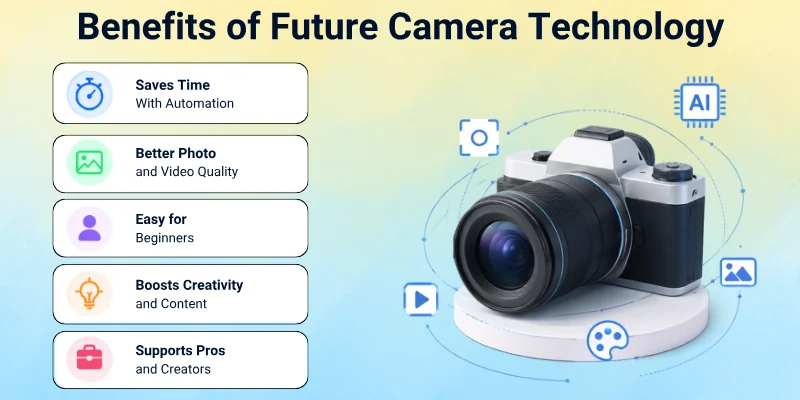
Here are the main benefits:
- Saves time with automation: Cameras will adjust settings automatically, so users can focus more on capturing moments instead of technical controls.
- Improves photo and video quality: Advanced sensors and AI tools will enhance clarity, colour, and lighting in every shot.
- Easy for beginners to use: Smart features will guide users step by step, making photography simple even for first-time users.
- Boosts creativity and content creation: Users will get smart suggestions for angles, lighting, and editing ideas to improve creativity.
- Supports professionals and creators: Advanced tools will help experts work faster and produce high-quality content with less effort.
Risks and Challenges of Future Camera Technology
Even with many benefits, future camera technology will also bring some challenges. These issues need attention to ensure safe and responsible use.
- Privacy and data security concerns: Smart cameras may collect and store sensitive data, which can create privacy risks if not protected properly.
- Over-dependence on AI systems: Users may rely too much on AI, which can reduce basic photography skills over time.
- Possible job changes in the photography field: Automation may change how photographers work, especially in editing and basic shooting tasks.
- High cost of advanced devices: New camera technologies may be expensive and not affordable for everyone at the start.
- Risk of misinformation through image manipulation: Advanced editing tools may be misused to create fake or misleading images.
Privacy and Ethical Concerns in Future Cameras
As cameras become smarter, ethical use becomes very important. Users and companies must ensure that technology is used in a safe and responsible way.
- Responsible use of AI photography tools: AI should support creativity, not be used to mislead or harm others.
- Protection of user data and images: Personal photos and videos must be stored securely and protected from misuse.
- Avoiding misuse of deepfake and editing tools: Advanced editing features should not be used to create fake content that spreads confusion.
- Fair and transparent AI usage: Users should understand how AI makes decisions and what data it uses, so trust remains strong.

Conclusion
So guys, this was our article on the future of camera technology. Today, we covered how cameras are changing and what we can expect in the coming years in a very simple and clear way.
We saw how camera technology has evolved from film cameras to smart AI-powered systems. We also learned how smartphones, professional cameras, drones, and filmmaking tools are getting smarter, faster, and easier to use. On top of that, AI is playing a big role in improving photo and video quality while saving time for users.
If we look at everything together, one thing is clear. Photography is becoming simpler, but also more powerful.
So, stay updated, keep practicing, and learn new skills. The future of photography is full of opportunities, and those who adapt early will benefit the most.
Frequently Asked Questions
Here are some common questions about the future of camera technology and their answers to help you understand the trends better:
The future of camera technology is smart, fast, and highly automated. Cameras will use AI to improve images and videos in real time. They will also become easier for beginners and more powerful for professionals.
Overall, photography will shift from manual control to smart assistance.
Cameras will become more intelligent and user-friendly. They will adjust settings automatically and improve image quality on their own. AI will handle most technical work.
- Faster autofocus and tracking
- Better low-light performance
- Automatic scene detection
- Real-time editing features
AI will not replace cameras completely. Instead, it will improve how cameras work. Traditional camera systems will still exist, but they will become smarter with AI support. AI will act as a helper, not a replacement.
Smartphone cameras will become much more powerful and advanced. They will offer DSLR-level quality in a small device. AI will enhance every photo instantly.
Smartphones will also include better zoom, stronger night mode, and multi-lens systems. Photography will become easier for everyone.
DSLR cameras will not disappear completely, but their use will decrease. Mirrorless and smart cameras will take their place in many areas. Professionals may still use DSLRs for specific tasks, but newer technology will lead the market.
AI will make photography faster and more accurate. It will automatically adjust lighting, color, and focus. This will help users take better photos without technical skills.
- Improves image quality instantly
- Reduces noise in low light
- Enhances portraits and backgrounds
- Suggests better composition
Smart cameras are devices that use AI and software to improve photos automatically. They understand what you are capturing and adjust settings in real time.
These cameras reduce manual work and improve results for all users.
Future cameras will change how photographers work. Many technical tasks will become automatic, so photographers can focus more on creativity.
Editing and shooting will become faster and more efficient.
However, photographers will still be needed for artistic vision, storytelling, and professional work.
Yes, camera technology is moving toward automation, but not fully. Cameras will handle most technical tasks, but human control will still matter. People will guide creativity while AI manages settings and adjustments.
Automation will make photography easier, not replace human input.
You can prepare by learning both photography skills and AI tools. Practice regularly and stay updated with new technology trends.
- Learn basic camera settings
- Practice mobile and digital photography
- Explore AI editing tools
- Improve creative thinking and composition skills
Stay consistent, and you will adapt easily to future changes.



- Be Respectful
- Stay Relevant
- Stay Positive
- True Feedback
- Encourage Discussion
- Avoid Spamming
- No Fake News
- Don't Copy-Paste
- No Personal Attacks
- Be Respectful
- Stay Relevant
- Stay Positive
- True Feedback
- Encourage Discussion
- Avoid Spamming
- No Fake News
- Don't Copy-Paste
- No Personal Attacks